Monday, October 7, 2013

The Denali Highway - Paxson to Cantwell


September 2013
It was a last minute decision – to go somewhere that we had not been before.  We have lived in Alaska 19 years and have never driven the Denali Highway in central Alaska.  The Denali Highway runs east and west between the two main roads (north and south) that connect Anchorage with Fairbanks.  Paxson and Cantwell are the two towns on each side of the highway.  The road is mostly dirt and gravel and has fairly low vehicle traffic.  In mid-September Mrs. T Bob had a spur of the moment desire to drive the Denali Highway.  So, we jumped in the motorhome and took off.
It is interesting to note that this road was the original road from Anchorage to Denali National Park.  In 1971 the Parks Highway was built as a more direct route from Anchorage to Denali National Park and Fairbanks.  The Wikipedia article gives a good description and background of the highway.  The Bureau of Land Management (BLM) has a brochure that describes the highway and highlights along the drive.
Due to the fact that we keep the motorhome stocked and mostly ready to go-  on a rainy September evening we just jumped in and started driving north.  We decided to drive the Glenn Highway up through Glennallen, Alaska.  It was raining hard most of the drive and you could start to smell the usual scents of autumn in the air.  We stopped at the newly found Tok Thai Truck in Glennallen, for dinner, before heading north on the Richardson Highway.
As the sun was getting lower on the horizon the rain finally turned from heavy drops to light sprinkles.  Recent road repair had eliminated many of the pavement frost heaves speeding up travel.  We arrived in Paxson as the sun started touching the horizon we peeled off the Richardson Highway onto the Denali Highway – 20 more miles until the campground.


The highway is paved for the first 20 miles and snakes you up high on the shoulder of rolling hills with an excellent views of multiple glaciers, Summit Lake, and the home of The Arctic Man.  We immediately noticed that there were pullouts on both sides of the road, about every half mile, where people were camped.  These pullouts continued the entire 135 miles (217 km) of the highway.  After driving about 20 miles from Paxson, we crossed a bridge over a swift moving river connecting two of the Tangle Lakes.  On the far side of the bridge we experienced the transition from paved to gravel road.  The turnoff for the BLM campground at Tangle Lakes was another 100 feet further.  The Tangle Lakes Archeological District occupies both sides of the road in the area approaching Tangle Lakes (~MP 16-38).  These archaeological sites show evidence of ancient peoples who had inhabited this area and it is listed on the National Register of Historic Places.  Off-road vehicle travel is limited to designated roads and trails in this area.
The Tangle Lakes campground consists of two loops for campsites bordered by a small hill on one side and Round Tangle Lake on the other.  Most of the campsites were occupied during our visit (our visit was near the beginning of the hunting season).  The small brush and grass in the area had turned yellow, red, and orange with the cooler temperatures (there are no large trees until you get near the Susitna River).  A strong wind from the southwest made it feel very cold.
The following morning we woke to a slight breeze and partial sun.  A hiking trail diagonals up the hill near the campground and we went for a short hike.  We had good views of Round Tangle Lake, campsites, and the Denali Highway heading east.  We turned around when we got to the ridge due to very strong winds in that area.  On the way down the hill we noticed wild blueberry bushes.  We reached down to pick a few and then noticed that blueberry bushes were everywhere.  Other than our pockets, we had no containers.  We filled up our pockets and ate blueberries as we walked down the hill.
We left the campground about 10:00 AM and started driving west on the Denali Highway.  
Blueberries hiding on the trail
The road was in good shape (for a gravel road), much better than I expected.  Even though it was raining for us the previous day there were very few puddles in the road – very few washboards also.  With that being said, there were a few areas of the road that were rough with ruts and large rocks in the road.  Overall, in a motorhome, we averaged about 30 miles per hour.
Stopping on the hill leading into the Maclaren basin, overlooking the Maclaren river (at ~4,000 feet elevation), revealed a large glacial carved valley covered in red carpet with a few gold highlights.  The highway, with multiple hunting camps occupying the turnouts, could be recognized for miles.  Multiple mountain peaks, lakes, and glaciers could also be seen in the distance.  After crossing the Maclaren river bridge, the next five miles of road were probably the roughest on the trip with potholes and softball sized rocks scattered in the road.

Multiple small lakes could be seen just off the road, many containing different types of wildlife including swans.  Around mile 59 the road rises up onto a small ridge known as an “esker” and continues for about 20 miles.  According to the BLM brochure, eskers are a ridge of silt and rocks that were deposited by a stream flowing within the glacier (that formed the valley) and left as elongated mounds.  The eskers in this valley are supposed to be some of the best examples in North America.
Denali Highway driving on Esker

About the time the eskers were ending, we started to see taller trees including evergreens (which we had not seen since leaving Paxson).  The road turns north where it eventually crosses a large bridge over the Susitna River.  After crossing the river, near milepost 85.5 (from Paxson), there is one of the many turnouts on the road.  There is a hill just behind the turnout that only takes a few minutes of hiking to reach the summit.  On top of this hill is an excellent view of the headwaters of the Susitna River and multiple mountain peaks and glaciers.  With binoculars it would be easy to spot the different wildlife living in the large valley.
Susitna River Bridge (looking East)

Headwaters of Susitna River


Another BLM campground at mile 104 is bordered by a river with rapids and fast moving current.  The area also included tall trees and a rocky landscape.  This campground would be worth checking out on a return trip.
The pavement started about three miles before arriving at Cantwell.  When we first started the trip I thought I would be happy to see the pavement after 130 miles of dirt road (especially driving a motorhome).  However, when we did hit the pavement I was disheartened because I knew the exploring was over.
Overall it was a great trip.  Much of the Denali Highway reminded me of the highway in Denali National Park that leads to Wonder Lake and close-up views of Mount McKinley.  There was more traffic than I expected but not overwhelming – much of it being hunters traveling to camps.  This would be an ideal trip for an adventure  motorcycle.  On the way home, a short trip into Talkeetna for dinner was a nice diversion.  The entire two day trip was about 600 miles in length and has been added to our list of short Alaska trip recommendations.

Monday, August 19, 2013

Tok Thai Food truck – Glennallen, Alaska


Quick review on the Tok Thai Food truck in Glennallen, Alaska (Ya, that's right- it is not in Tok - it is in Glennallen - maybe it was born in Tok???).  I have heard about this from quite a few people who have loved it.  On a drive (with M Bob) from the Canadian border to Anchorage, we looked for a “purple truck” in Glennallen and found it, in a semi-permanent location, right next to “The Hub” in Glennallen.  When we walked up to the truck there were three Ukrainian tourists taking photos of the truck and waiting for their food.  I quickly spotted yellow curry chicken on the menu and placed an order – M Bob ordered the fresh spring rolls.  I have been on a quest, around the country, for the perfect Thai yellow curry for years.  The closest I have found is at Ray’s Place in Anchorage, AK – until today.  By the time our food was ready there was a lunch-time line of about 20 people with cars parked haphazard all around the truck - and more coming out of the woodwork.


Cutting to the chase here – the yellow curry was great. – just the right amount of coconut milk, curry, chicken, and potatoes.  The chicken was cooked perfectly (one of the faults of many of the previous attempts in my quest).  The fresh tofu spring rolls were also very tasty.  It seems strange that food served in the middle of Alaska can taste so fresh.  If you have any stickers, there is still room to strategically place them on the truck.

It is almost worth the drive… to Glennallen - not Tok.

If you have been there - leave a comment below.

The Good
  • Great Thai food
  • Quick service
  • Scenic drive to Glennallen
  • Display your sticker!

The So-So
  • Cold weather dining?
  • Expensive gas at The Hub

The Not-Good
  • Anticipating the food during the drive if you don't live in Glennallen - "no snacking"
  • The line - if you are late

Thursday, August 8, 2013

Country Tavern BBQ - Kilgore, Texas


Country Tavern BBQ - Kilgore, Texas

Restaurant Review

I have been on a quest for good BBQ brisket and I just had a new entry in the top three.  The best BBQ brisket I have ever had – so far, has been at Speedy Pig BBQ and Restaurant in Russellville, Alabama.   Speedy Pig’s motto for their mobile smoker is “You croak ‘em, we smoke ‘em.”  Second is Honey Bears BBQ in Phoenix, Arizona (on Van Buren) where their motto is “You don’t need no teeth to eat our meat.”  Coming in at number three is a BBQ that I recently visited – Country Tavern in Kilgore, Texas (could not find a website).  I am a non-Texan but heard this place was “famous” and it was good to give it a try.

Country Tavern does not have a printed menu.  Your server will recite “brisket, ribs, turkey, and sausage” as main entrées.  I am a big brisket fan but after seeing the ribs and turkey I wish I had more room to try them.  Sides include the usual “tater salad, potato smash, cole slaw,” etc.  The restraint is a large hall with a bar at the end making it somewhat noisy.  It was almost full with large groups and families at some tables.  Arrived at Country Tavern at 7 PM, hungry and thirsty, after a long day logging in the woods in 105-degree temperatures.

Food
Brisket was moist and smoked to perfection.  The serving was large – large enough that I was not able to finish.  If I were not living out of a suitcase, I would have taken some home.  We had four people in our party - everyone ordered brisket but one, who ordered ribs.  The ribs looked awesome.  Coleslaw was very good but the “tater salad” was somewhat bland.  I doubt there was any salt on it and probably not much else for spice.  Only one BBQ sauce was available which was vinegar based, very good, and tangy.

Service
Staff was very friendly (of course – we are in Texas).  I seemed like staff were very busy at tables spending extra time with the larger groups.

The Good
  • Moist, flavorful brisket
  • Ribs! (second hand report)
  • Coleslaw
  • Pleasant staff


The So-So
  • Menu?
  • Slightly more expensive than most BBQ
  • Crowded


The Not-Good
  • Noisy – sometimes difficult to carry on a conversation
  • “Tater salad”

Monday, July 29, 2013

Backpacking Lost Lake Alaska


Adventure Review

Lost Lake Trail
From:  Kenai Lake (Primrose trail), Alaska
To: Seward, Alaska (Lost Lake trail)
Length: 17 miles
Date: July 2013
 
Primrose trailhead
As an Alaska resident it seems fairly frequent that you hear someone mention the Lost Lake trail and how beautiful it is.  Many people saying it is one of the most scenic trails in Alaska.  In July 2013 I had the opportunity to experience this trail first hand.

Preparing for this trip was fairly easy.  We were spending only one night hiking from the south end of Kenai Lake up the Primrose trail to Lost Lake then to Seward spending the night at Lost Lake.  Hiking 17 miles in two days is not a problem for most people.  Even though there is a considerable elevation gain it seems gradual with only a few short steep areas.

The trail is maintained very well being well defined and includes well-built drainages to prevent trail erosion.
About two miles north of Lost Lake


Things to keep in mind:
You can do this hike one-way form Kenai Lake to Seward without shuttling a car.  There are quite a few taxi companies in Seward that will pick you up at the end of the trail (either side) and take you back to your car.  This should cost $30 to $40, plus tip.  Other options are to hike form either trailhead, to the lake, and back.  Or, bring two cars and shuttle.

Camping, near the lake, is in established backpacker campgrounds only.  There seems to be about a dozen campgrounds near or at the lake.  There are “bear proof” cabinets to store food at most of the campgrounds so no need for bear proof barrels or bear bags of you stay in an established campground.
Campsite on small lake located on outlet of Lost Lake

At the time of our trip there was a fire ban and no fires were allowed.  All cooking had to be done with a stove.  We did not see any established fire rings to have fires at any of the campgrounds.

Mountain bikers share this trail.  Don’t be surprised to see bikes quickly come up behind you or around corners.

Runners frequently use this trail many completing a one-way trip in four hours or less.  There is an organized race for trail runners in August of each year.
A camera is a must.
Early morning fog

The Good
  • Scenery
  • Forest, alpine, scenery
  • Food lockers to keep bears away
  • More scenery
  • Photo opportunities a plenty
  • Well maintained trail
  • Bonus waterfall on Primrose trail
  • Awesome views of Resurrection Bay and Kenai Lake (did I say scenery?)


The So-So
  • Fairly busy trail
  • Campsites at Lost Lake can fill quickly
  • Ridge hiking may be windy
  • Fog
  • Trail covered in snow in early season


Links

Monday, July 15, 2013

Contour HD Video Camera


Product Review

This is not a lengthy review – This review contains highlights from my experience with the Contour HD camera.  Feel free to leave comments with your experience.


I enjoy editing video and making movies as a hobby since I was very young.  In the early 70’s I taped a 8mm movie camera (not Super 8) to the top bar of my bike for a POV shot of going off a jump in a local church parking lot.  When I landed, the tape broke and the camera fell off my bike and tumbled to the ground to be slowed before impact by the last length of tape, inches above the asphalt.  It was all recorded on film.  That was 40 years ago.  The recent invention of the new smaller “helmet cams” makes action videos is much more practical.

About three years ago (Spring 2010) I started hearing about, and seeing video from new small high definition (HD) video cameras. I imagined making some amazing HD video shots if I could get my hands on one of these small, rugged, lightweight, mount anywhere, video cameras.  At that time, two main brands were becoming popular GoPro and Contour.  In May of 2010 I purchased a Contour HD and in this review I will tell you why.

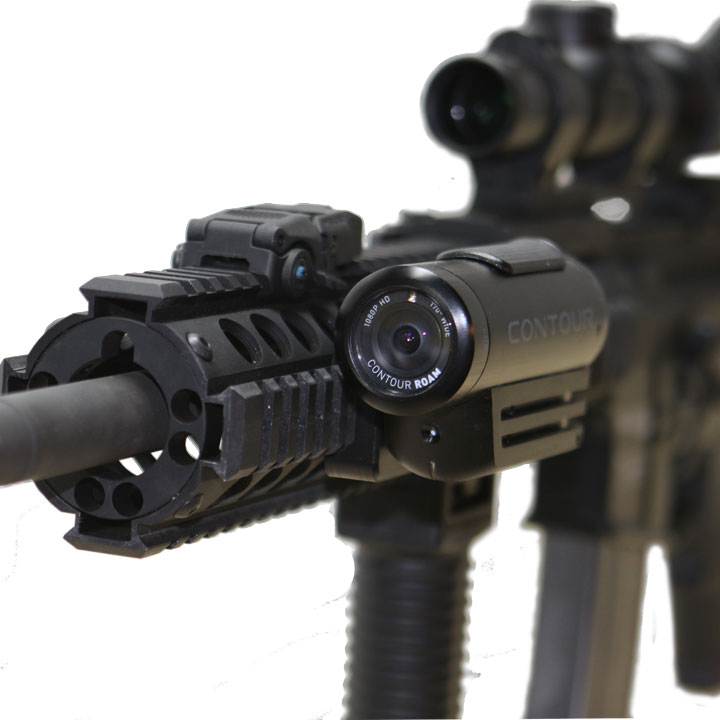
As of this posting, the Contour HD camera is still available for purchase even though newer models, with updated features, have been introduced over the last few years.  Why did I choose a Contour HD camera over the GoPro?  I chose the Contour over the GoPro for a few different reasons – the main reason being the shape of the camera.  The 2010 model GoPro was big and boxy (the newer versions are slightly smaller).  The Contour HD was smaller and was more streamlined.  Both cameras had plenty of mounting options and these options have even increased further over the last few years.  The Contour HD had an optional Picatinny rail mount.  At the time I could not find one for the GoPro.  Picatinny mounts are commonly found on firearms (used for lights, lasers, grips, etc.) but Picatinny rails can be mounted firmly on almost any solid object making it a good universal mounting system.  Buy a rail for a few dollars, screw or bolt it on to something, then slide the camera with the Picatinny mount onto the rail.  It is a solid strong mount.  The Contour camera also had an option of a rubber strap mount that can be wrapped around poles, sticks, or anything tubular 1 to 8 inches in diameter opening up even more possibilities for mounting.  These are the two main reasons why I went with the Contour HD.


The Contour HD is capable of both 720 and 1080 high definition.  Most small cameras available prior to the Contour HD were standard definition and fairly affordable ($270.00 USD) at the time.  With my Contour HD camera I have mounted it to dogsleds, motorcycle forks, rifle, pistol, wagon wheels, helmets,

The Good
  • HD video
  • Plenty of mounting options
  • Streamlined shape
  • Battery and video can last for many hours of continuous shooting (4 hours at 720p with 16GB memory card).
  • Laser lens alignment
  • Water resistant – waterproof case available. Camera can be mounted at almost any angle (on its view axis) and compensated by rotating the lens in the camera.  Two lasers help to make sure lens is aligned with horizon.


The So-So
  • No viewfinder – has lasers for alignment.
  • No video monitor.  Need to connect to computer to preview any video footage.


The Not-Good
  • No on camera adjustments for sound levels or exposure. You can adjust exposure and audio recording levels while connected to a computer, using Contour’s software (comes with camera).
  • Uses MicroSD memory cards.  Small, but not as common.
  • No plug for external microphone.
  • Rolling shutter “jelly” effect when camera is experience heavy vibration (e.g. biking rough trail or mounted on motorcycle frame).


Links


Tundra Bob